

“Tune-up” gets used loosely enough that many homeowners are not sure if it means someone glancing at the furnace for ten minutes or a real inspection. Here is what a real heating tune-up and a real AC tune-up should include, what a technician is measuring in your basement or on your roof deck, and why it is a small, predictable visit next to a mid-season breakdown or a shortened equipment life.
Why is a tune-up worth the hour it takes?
Heating and cooling equipment does not fail randomly. It fails because something was drifting out of spec for months: a dirty flame sensor, a slowly weakening capacitor, a coil losing airflow to dust. Nobody caught it until it gave out, usually on the coldest or hottest day of the year. A tune-up is the chance to catch that drift early, while it is still an adjustment instead of a breakdown. It is the core of what we mean by HVAC maintenance, whether that is a one-off visit or a standing arrangement.
What is on a heating tune-up checklist?
Furnace tune-up
- Inspect and clean the burner assembly and ignition components
- Inspect the heat exchanger for cracks, which is a carbon monoxide safety issue, not a performance one
- Check the flue and venting for proper draft
- Replace or clean the filter
- Inspect the blower motor and belt (if belt-driven) for wear
- Test safety controls, including the limit switch and flame sensor
- Check thermostat calibration and operation
- Measure static pressure and airflow across the system
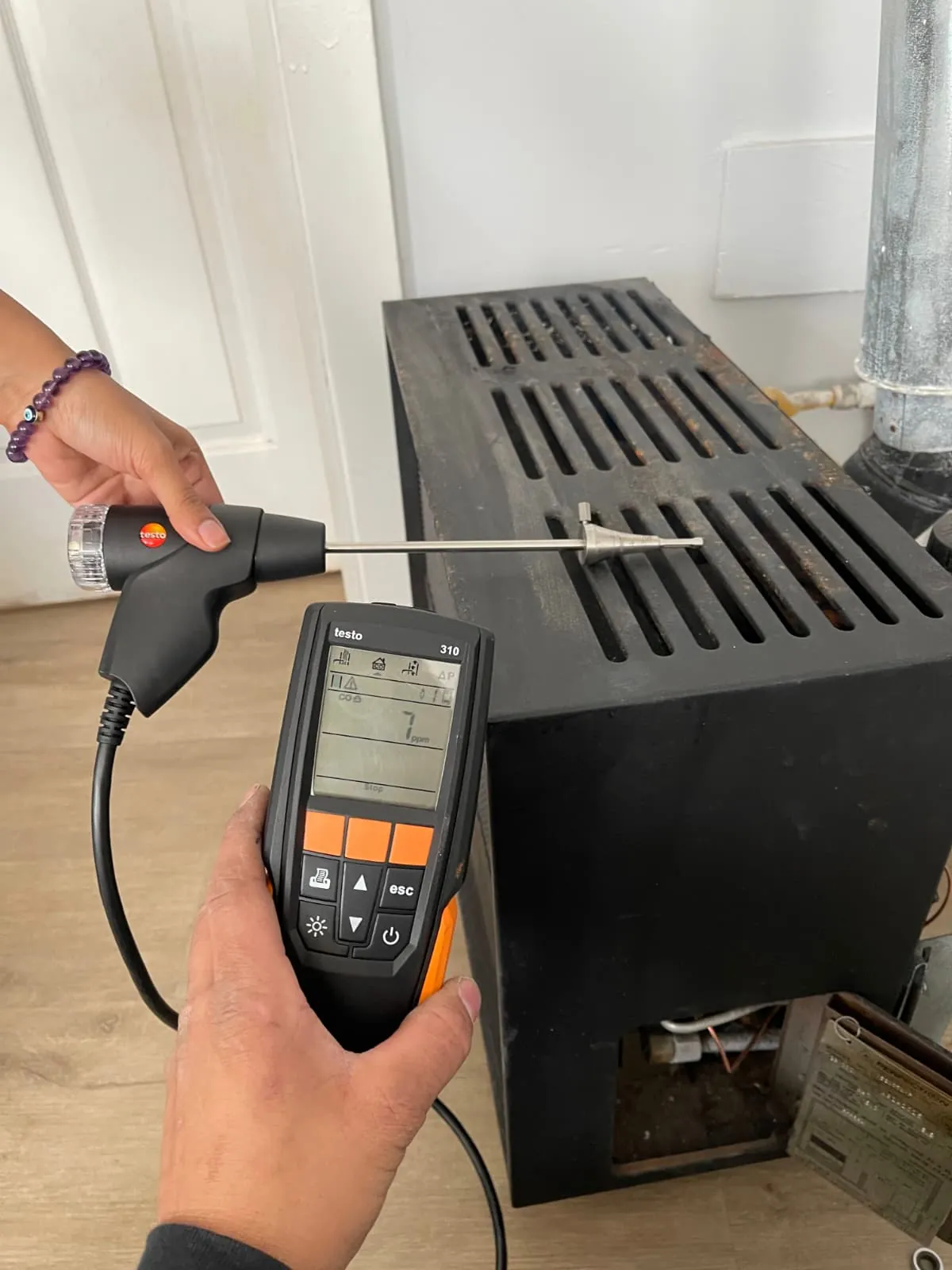
- Run a combustion analysis, measuring CO output, oxygen and CO2 levels and stack temperature
Boiler tune-up
- Inspect and test the circulator pump or pumps and the zone valves
- Check expansion tank pressure
- Test the aquastat and the pressure relief valve
- Bleed air from radiators or baseboard zones as needed
- Check system water pressure and look for signs of leaks at unions and valves
- Run a combustion analysis on gas or oil burners, the same as a furnace
See our boiler page for the oil and gas boiler side.
What is on a cooling tune-up checklist (AC and heat pump)?
- Clean the evaporator coil and condenser coil, both of which lose efficiency fast once coated in dust or, outdoors, pollen and debris
- Check refrigerant charge by measuring superheat and subcooling, not by topping it off without checking whether it needs it
- Clear the condensate drain line and test the float safety switch
- Tighten electrical connections and check the capacitor and contactor for wear, since these are common causes of a system that hums and will not start
- Check thermostat operation and, on a heat pump, confirm it switches between heating and cooling correctly
- Measure airflow and static pressure
- Check that the outdoor unit is level and has clear airflow on all sides
- Replace or clean the filter
Mini split systems get a version of this list, with more emphasis on cleaning the indoor unit’s filter and coil. You can clean the filter between professional visits. Our HVAC maintenance page covers the schedule.
What is a technician actually measuring?
A lot of this sounds like jargon until someone translates it. Static pressure tells us how hard the blower is working to push air through your ducts. High pressure usually means a restriction: a dirty filter, a closed damper or undersized ductwork. Superheat and subcooling tell us whether the refrigerant charge is correct, rather than guessing from how cold the air feels at a vent. Combustion analysis tells us how safely and how efficiently a gas or oil burner is running, since a burner can look fine and still produce dangerous CO levels or waste fuel. None of this is guesswork. It is the same handful of measurements every time, compared against what the equipment is supposed to be doing.
What does a tune-up prevent?
Four things, mainly:
- A mid-season no-heat or no-cool breakdown, which always seems to happen on the worst possible day.
- A carbon monoxide safety issue that goes unnoticed because nobody ran a combustion analysis.
- A shortened equipment life, since a system fighting dirty coils or low airflow all season wears out faster than one that is clean and properly charged.
- A higher utility bill than you should be paying, since an out-of-spec system is an inefficient one even when it still works.
How often do you need a tune-up?
Once a year for your heating system, ideally in the fall before you need it, and once a year for your cooling system, ideally in the spring before the first heat wave. If you have a heat pump doing both jobs, that is still two seasonal visits, since the system works hard in both directions. Mini split filters benefit from more frequent cleaning between professional visits, especially in a household with pets.
What does a tune-up cost compared with a repair?
A standalone tune-up is a small, predictable visit. It is well below an emergency no-heat repair and nowhere near a full system replacement. Think of it as the cheapest insurance your furnace or AC has, since almost every expensive repair we see traces back to something a tune-up would have shown months earlier. We do not publish prices. We tell you the visit price when you call or book, and you approve it before the work starts.
Do you have a maintenance plan?
We are putting together maintenance options for customers who would rather not think about scheduling two visits a year. Use the button below to ask for information. It is a request for information, not a purchase or an enrollment.
Learn About Our Maintenance Options
In Massachusetts and Rhode Island
Tune-ups matter more here than in milder places. Heating systems run for most of the year, oil burners need their nozzle and filter changed before the first cold snap, and salt air near the coast shortens the life of outdoor coils. We have done maintenance visits in Lakeville, Fall River, Middleborough, New Bedford and Taunton, and in Rhode Island towns including Warwick and Pawtucket. Fall is the time for the boiler or furnace, and spring is the time for the AC.
Questions about furnace and AC tune-ups
Is a tune-up necessary if nothing is wrong?
Most of what a tune-up prevents does not announce itself. A slowly failing capacitor or a coil losing airflow to dust makes no noise until the system stops. A cracked heat exchanger or an unsafe combustion reading does not show up at all without the right test equipment. “Nothing is wrong” and “nothing has been checked” are not the same thing.
What is the difference between a heating tune-up and an AC tune-up?
A heating tune-up focuses on combustion safety and efficiency: burner condition, heat exchanger integrity, venting and CO output. An AC or heat pump tune-up focuses on refrigerant charge, coil condition and electrical parts, since those affect cooling performance and compressor life. A heat pump needs both, since it does both jobs.
Does a tune-up include a refrigerant top-off?
It includes checking whether the refrigerant charge is correct, not automatically adding refrigerant. A sealed system should not need refrigerant added during a routine tune-up. If the charge is low, that usually means a leak, which is a separate conversation.
How long does a typical tune-up take?
Usually about an hour per system for a thorough visit, longer if something needs adjustment or more diagnosis. A rushed fifteen-minute tune-up generally is not checking most of what is on the lists above.
Next step
Call Armus Mechanical at 508-521-9477 to schedule a visit. The phone is answered 24/7. We are based in Lakeville and come to your home or business across the SouthCoast, South Shore, Cape Cod and Rhode Island. Or ask about maintenance options.