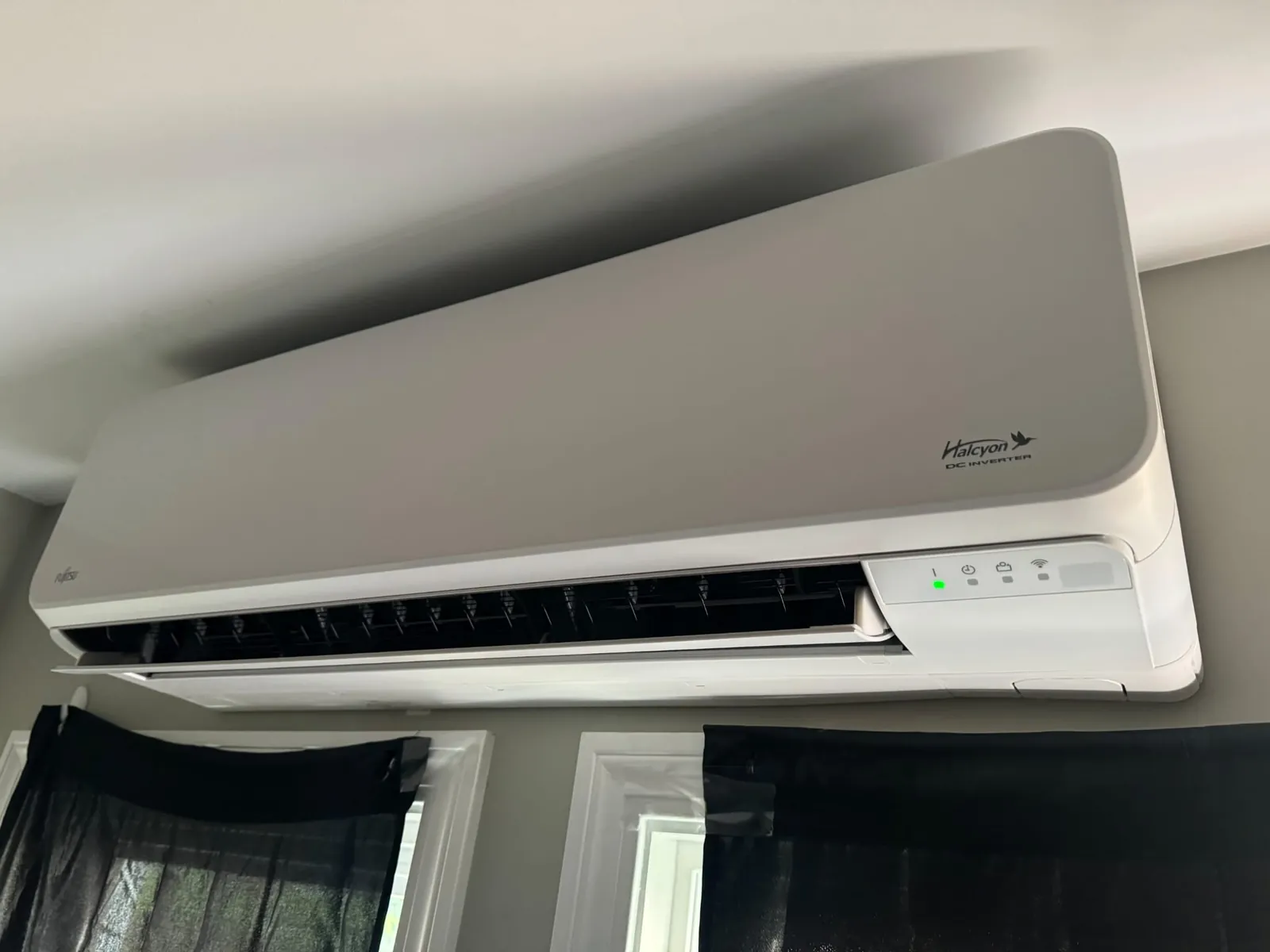

Fujitsu and Mitsubishi are the two mini split brands we install the most at Armus Mechanical, from three-decker rental units in New Bedford to shingle-style capes on the Cape Cod side of the bridge and colonials up in the South Shore towns. Mini splits are also called ductless systems. Both are good equipment. Neither one is the “wrong” answer. But the right pick for your house depends on things a sales flyer does not cover: how cold it actually gets at your address, what your electrical panel has left in it, and what kind of rooms you are trying to heat and cool. Here is how we think about it on a site visit. This comparison is part of our broader heat pump and mini split installation work out of Lakeville.
Why does it come down to these two brands?
We can work with other lines too, but Fujitsu and Mitsubishi are what we recommend most, for a plain reason. Both are established manufacturers with deep U.S. distribution, which means when a control board or capacitor fails in the middle of a February cold snap, we can usually get the part that week instead of waiting on a container ship. Cheaper, less-established brands can look identical on a spec sheet and still leave you waiting weeks for a part in January. If you are cross-shopping a third option, we wrote the same kind of comparison for Mitsubishi vs. Carrier.
Both brands also list cold-climate models on Mass Save’s Qualified Product List (QPL), which matters if you plan to apply for a heat pump rebate. Not every configuration of every model qualifies automatically, so we confirm the specific equipment against the current QPL as part of your estimate rather than assuming. Middleborough Gas & Electric and Taunton Municipal Lighting Plant customers are outside Mass Save’s electric rebates and may have their own programs; we point each customer to the right program.
Cold-climate heating: how does each handle a New England winter?
Both manufacturers build a dedicated cold-climate tier engineered to keep delivering close to full heating capacity well below freezing, instead of leaning on electric-resistance backup heat the way older or bargain mini split units do once the outdoor temperature drops. Mitsubishi markets its version as Hyper-Heat. Fujitsu generally sells the equivalent under an XLTH, or extra-low-temperature heating, designation.
In practice, both are built to keep producing real heat down into single-digit and sub-zero outdoor temperatures, which matters on the handful of nights a year that Bristol County, the South Shore or the Cape actually see single digits. The standard, non-cold-climate version of either brand cools well and heats fine into the 20s and 30s, but starts losing capacity sooner. If the mini split is going to be a room’s only heat source, or the backup plan for an oil boiler that is on its last legs, specify the cold-climate tier. It costs more up front and it is worth it.
What do the efficiency tiers mean, in plain English?
Both manufacturers sell a few efficiency tiers within each brand, and both like to lead with performance numbers on the spec sheet. Skip those. Here is what changes as you move up a tier: quieter operation indoors and out, better performance when the system is running at partial load (which is most of the time), better dehumidification and a lower electric bill for the same comfort.
An entry-level single-zone unit is fine for a bonus room, a garage or a space you will run occasionally. A mid- or top-tier unit is worth the extra money on a primary living space, a bedroom you sleep in every night, or a whole-home multi-zone system you will run nine or ten months of the year, because that is where the efficiency difference shows up on the electric bill.
What about warranty coverage?
Both Fujitsu and Mitsubishi back their residential mini splits with extended parts and compressor coverage well beyond a standard one-year warranty, when the system is installed and registered by a contractor within the manufacturer’s registration window. Miss that window and coverage usually drops back to a shorter base warranty. We register every system we install, so that is never something you have to track down later. Exact terms and registration periods are set by the manufacturer and do shift over time, so we confirm current coverage at the time of your install rather than quoting last year’s fine print. For more on Mitsubishi’s lineup, see our complete guide to Mitsubishi mini split systems.
What changes the cost?
We do not list prices, because the real number depends on your house. The brand matters less than these things:
- Line-set length.
- The style of the indoor head.
- The number of zones on each outdoor condenser.
- Your electrical panel’s capacity. Any additional electrical work required for your mini split installation is identified in the project estimate.
A single-zone system serves one room with one outdoor condenser and one indoor head. A two- or three-zone system, common in a New Bedford or Fall River multi-family unit or a Cape ranch, adds multiple indoor heads, line-set runs between each head and the outdoor unit and an outdoor condenser sized for the combined load. Whole-home replacements covering four or more zones take more scope still. If you are applying for a Mass Save heat pump rebate, it can offset part of the installed cost. The way to get a real number is a site visit, which starts with our estimate request.
Which brand fits which house?
Older capes, colonials and homes with no ductwork
Both brands do well here, and this is the classic mini split use case: an oil-heat Dartmouth cape with cast-iron radiators and no existing ductwork, where the family wants central-style comfort without opening up plaster walls to run ducts. One to four wall-mounted indoor heads, tied to the rooms that need it most, usually solves it.
Additions, garages and bonus rooms
A single-zone unit from either brand is a common, cost-effective pick for a standalone space that does not need to share an outdoor condenser with the rest of the house, like a converted garage in Middleborough or a South Shore three-season room somebody wants to use in January too.
Whole-home multi-zone replacements
Mitsubishi’s larger multi-zone outdoor units, and Fujitsu’s comparable multi-zone lineup, both handle five- to eight-zone whole-home layouts without much difficulty. At that scale the real decision usually comes down to which brand’s indoor head styles fit the specific rooms, a ceiling cassette in a finished basement or a slim ducted unit hidden in an attic feeding two or three bedrooms from one air handler, more than the brand itself.
Coastal and Cape installs
Salt air off Buzzards Bay or Cape Cod Bay shortens the life of an unprotected outdoor condenser coil faster than most homeowners expect. Both manufacturers offer corrosion-resistant coil treatments for coastal installs, and we recommend asking for it on anything going in near saltwater, including Fairhaven’s waterfront, Wareham, Falmouth and Sandwich.
How does Armus decide on a site visit?
We do not quote a brand over the phone. On site, we run a load calculation based on your actual square footage, insulation, window count and type, and the real design temperature for your town rather than a generic default. We check your electrical panel for available capacity and breaker space, since a multi-zone system needs a dedicated circuit sized for the outdoor condenser. We look at where the line sets would actually run between the indoor heads and the outdoor unit, both for efficiency and for how it will look on the outside of your house.
Then we ask how you plan to use it: supplemental cooling for one room, or the primary heat source replacing an aging oil boiler. That changes whether the cold-climate tier and whole-home eligibility make sense for your project. Only after all of that do we land on Fujitsu, Mitsubishi or occasionally a mix across separate zones, based on which lineup’s head styles and zone combinations fit your rooms.
Questions about Fujitsu and Mitsubishi
Is Fujitsu as good as Mitsubishi?
For most Massachusetts homes, yes. Both are established manufacturers with strong dealer networks and available parts, both build cold-climate lines rated for New England winters, and both have models on Mass Save’s qualifying equipment list. The better question for your house is which lineup’s zone count, indoor head styles and cold-climate tier fit your rooms and budget, which a site visit answers.
Which brand heats better in extremely cold weather?
Both brands’ cold-climate lines, Mitsubishi’s Hyper-Heat and Fujitsu’s XLTH-designated units, are engineered to keep producing meaningful heat well below freezing instead of falling back on backup electric resistance heat. We have had good results from both in SouthCoast and South Shore winters. What matters more than the brand badge is making sure you specify the cold-climate version, not the standard one, if the mini split is doing real heating work in your home.
Do Fujitsu and Mitsubishi mini splits qualify for Mass Save rebates?
Many of their cold-climate models appear on Mass Save’s Qualified Product List, which is required for rebate eligibility, but not every model or configuration qualifies automatically. We confirm which specific equipment and installation type qualifies as part of your estimate. Current rebate amounts and program rules are posted at masssave.com and do change, so we check them fresh rather than quoting old numbers.
How long do these systems last?
Equipment life varies with installation, maintenance and operating conditions. Annual maintenance helps, and coastal salt exposure and how consistently the filters and coils get cleaned both affect how long a given system lasts.
Can I mix Fujitsu and Mitsubishi equipment in the same house?
You generally cannot mix brands on the same outdoor condenser and indoor head system, since the components are matched and communicate with each other. It is common, though, for a house to run one brand’s multi-zone system on the main living areas and a separate single-zone unit from either brand on an addition or garage. We will tell you upfront if that split makes sense for your layout.
Next step
A new install or replacement gets a free written estimate.
Call Armus Mechanical at 508-521-9477. The phone is answered 24/7. We are based in Lakeville and serve the SouthCoast, South Shore, Cape Cod and Rhode Island.