
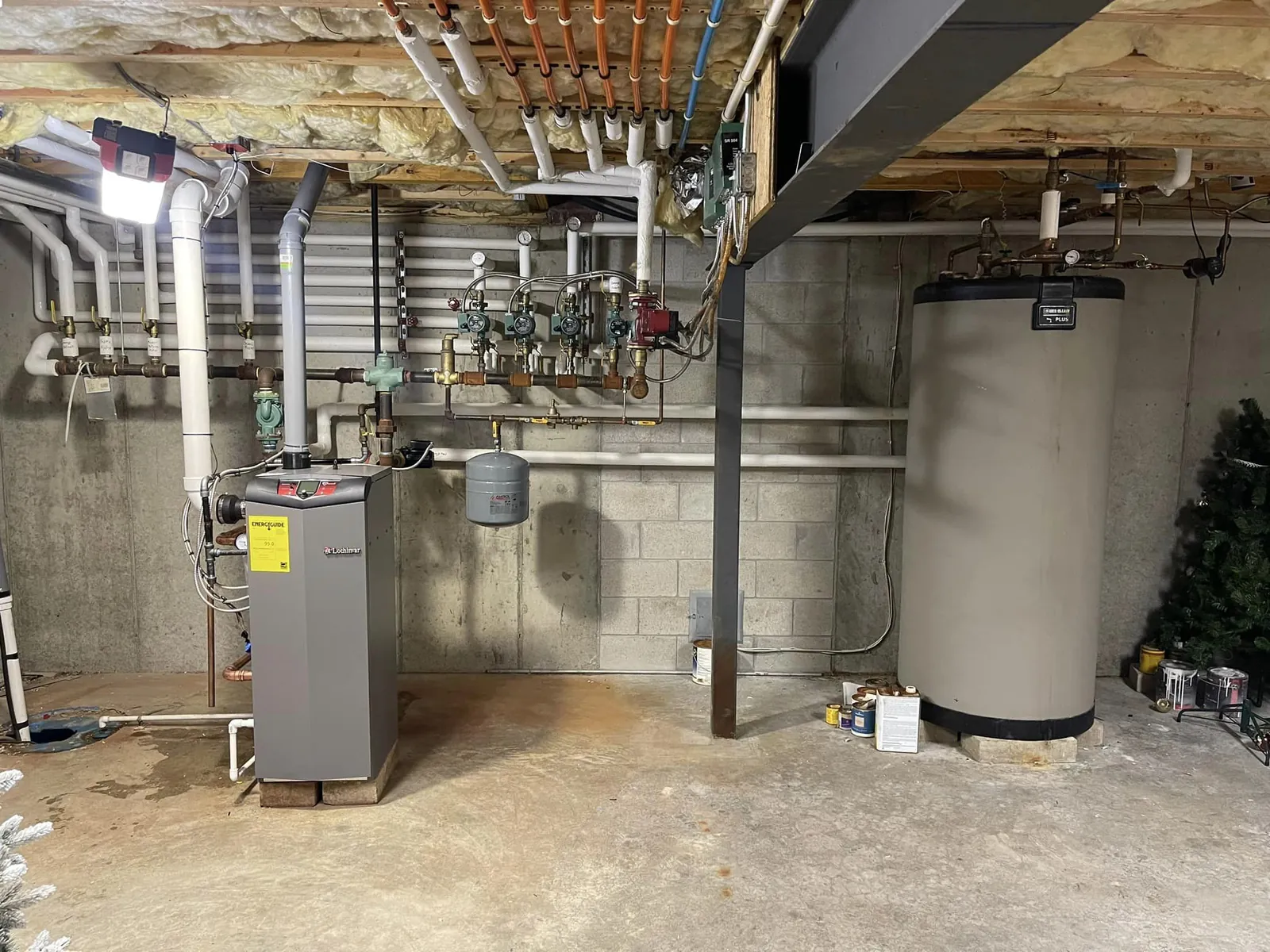

A lot of the housing stock across the SouthCoast, the South Shore and Cape Cod still runs on a boiler with radiators or baseboard, on oil or gas, and sometimes both at different points in a house’s life. When one starts failing, the first question is always the same: what is this actually going to cost. This guide covers what sets the cost of a new boiler in Massachusetts and when a repair is the smarter call. It does not list prices, because the real cost depends on your piping, venting and heat load. The only way to get a real number for your house is a site visit.
Gas vs. oil: what changes the price?
If your street already has a gas main and your house is already piped for gas, a gas boiler is usually the simpler install, since you are not dealing with an oil tank, oil lines or annual delivery. If gas is not run to your house yet, bringing it in involves the gas utility that serves your town. That is a separate cost and timeline outside the boiler installation, and sometimes a significant one depending on how far the main is from your foundation. For a lot of SouthCoast homes that already have a working oil tank and line, staying on oil for the boiler swap avoids the gas-main question entirely.
Standard efficiency vs. high-efficiency condensing
A standard-efficiency boiler, cast iron or steel, usually vents through your existing chimney and is the simpler swap when the chimney is in good shape. A high-efficiency condensing boiler runs hot enough to pull extra heat out of the exhaust. It does not need a masonry chimney. It vents through PVC pipe straight out a sidewall, but it also makes acidic condensate that has to be drained, usually through a small condensate pump if there is no nearby floor drain. Condensing boilers cost more up front and use less fuel over time. Whether that pays off depends on how long you plan to stay in the house and what your current chimney is doing. An unused, deteriorating chimney can be its own expense down the road.
What drives the price on any boiler job?
Past the fuel type and efficiency tier, a handful of things move the number more than anything else:
- The boiler’s output size, measured in BTU, which has to match your home’s actual heat loss, not just match the old unit
- How many heating zones the house has, and how many circulator pumps and zone valves that means
- Whether the existing chimney needs relining, or whether a condensing unit’s new sidewall vent has to run through masonry or framing
- The condition of the existing piping, especially the near-boiler piping, which sometimes needs to be redone regardless of which new boiler goes in
- Electrical work, if the new boiler’s controls need a dedicated circuit. Any additional electrical work required for your boiler installation is identified in the project estimate.
- Removal and disposal of the old boiler, and the old oil tank if you are converting away from oil at the same time
Two houses with the same square footage can land at very different numbers because of what is already there, not because one contractor is charging more than another.
What do the common boiler jobs involve?
We do not list prices, because each house is different. This is what the three common jobs involve:
- Standard-efficiency gas boiler: A straightforward swap that vents into an existing chimney.
- High-efficiency condensing gas boiler: Sidewall venting and condensate handling. More work if new gas service or a full re-zoning is involved.
- Oil-fired boiler replacement: Depends on the condition of the tank and the near-boiler piping.
Multi-zone homes, homes that need a chimney liner and homes that need significant electrical or piping work take more scope. If you want next steps on the gas side, our oil-to-gas conversion page covers what that process involves. We also work on steam boilers: service, repair, replacement and new installation.
Adding an indirect water heater
An indirect water heater is a separate insulated tank that uses your boiler as its heat source instead of running its own burner. It is generally more efficient than an old-style tankless coil built into the boiler and gives you more consistent hot water, especially in a household with more than one bathroom running at once. Adding one to a new boiler installation adds scope: the tank, the piping and an additional zone valve or circulator. It is less if the new boiler is already sized with the extra capacity in mind, and more if the boiler has to be upsized to keep up with both heating and hot water. See our water heater page for how indirect tanks compare to standalone gas, electric and heat pump water heaters.
When does repair beat replacement?
Not every service call ends in a new boiler, and it should not. A circulator pump, a zone valve, an igniter or a failed aquastat are all common, relatively inexpensive repairs on an otherwise sound boiler. Replacing the whole system over one of these is usually a waste of money. The math starts to favor replacement when the boiler is in the 15 to 20-plus year range, when a repair estimate starts approaching a third or more of what a new system would cost, or when the problem is a cracked heat exchanger or a leaking cast iron section. Those generally are not repairs. They are the boiler telling you it is done. If your oil burner only needs its annual service, our oil burner maintenance guide covers what that should include.
Oil-to-gas and oil-to-heat-pump alternatives
When a boiler fails, it is a natural point to ask whether to replace it in kind or switch fuels. Moving from oil to gas usually means coordinating with the gas utility that serves your town. That is a regulated process, since gas utilities in Massachusetts operate under the Department of Public Utilities, and it only makes sense where gas is reasonably close to your house. Moving from oil, or an aging boiler in general, to a heat pump is a different kind of decision. A heat pump replaces both heating and cooling in one system rather than being a like-for-like swap, and it opens the door to a Mass Save heat pump rebate. Middleborough Gas & Electric and Taunton Municipal Lighting Plant customers are outside Mass Save’s electric rebates and may have their own programs; we point each customer to the right program. We cover the process in our heat pump guide. Neither switch is automatically right for every house. It depends on your current fuel costs, what is already run to your property and how long you plan to stay.
In Massachusetts and Rhode Island
Boilers heat much of the older housing in New Bedford, Fall River, Taunton and the towns around them, and many of those systems run on oil. Whether a gas boiler is an option depends on whether gas runs down your street, and the gas utility that serves your town decides about the main and the service line. Damp basements near the coast are hard on boilers and tanks. We have done boiler repairs in Fall River, Taunton, New Bedford and Fairhaven, and we serve Rhode Island from Lakeville as well.
How does Armus price your boiler?
We do not price a boiler off a phone call or a photo of the nameplate. A site visit lets us calculate your home’s heat loss, look at your existing piping and venting and see what condition the chimney or the oil tank is in. Those change the real number more than the brand of boiler does. You get an itemized written estimate before anything gets ordered. A replacement gets a free written estimate. Request an estimate. See our boiler services page for the brands and configurations we install and service.
Questions about boiler cost
How much does it cost to replace a boiler?
The cost depends on the fuel (gas, oil or steam), whether the new boiler is standard efficiency or condensing, and its size from the house’s heat loss. The number of zones, the venting or chimney work, the condition of the near-boiler piping and the removal of an old tank also move it. We do not list prices, because two houses of the same size can land far apart. A replacement gets a free written estimate.
Is a gas boiler cheaper to install than a high-efficiency condensing boiler?
A standard-efficiency gas boiler is usually less to install than a high-efficiency condensing model, mainly because it can often reuse your existing chimney venting instead of needing new sidewall venting and condensate handling. The condensing unit costs more up front but uses less fuel over its life, so the better choice depends on how long you plan to stay in the house.
How long does a boiler installation take?
A straightforward like-for-like swap, with the same fuel and reusable venting, typically takes one day. A job that involves relining a chimney, converting fuel types, re-zoning the piping or adding an indirect water heater can take two to three days. We give you a realistic timeline during your site visit based on your actual job.
Can I add an indirect water heater to my existing boiler?
Often yes, as long as the existing boiler has enough spare capacity to handle both heating and hot water without falling behind on either. If it does not, we will tell you upfront rather than install a tank that underperforms. It may be a better argument for doing the indirect tank at the same time as a boiler replacement.
Should I switch from oil to gas or go straight to a heat pump?
It depends on what is available at your property and your long-term plans. Oil-to-gas makes sense when a gas main is close by and you want to keep a boiler-and-radiator or boiler-and-baseboard system. A heat pump replaces both heating and cooling in one system and can qualify for a Mass Save rebate, but it is a bigger decision than a fuel swap. We walk through both on a site visit rather than pushing one over the other.
How do I know if I need a replacement instead of a repair?
Age is the first signal. Boilers in the 15 to 20-plus year range are worth evaluating rather than automatically repairing. The second signal is the repair itself: a failed circulator or zone valve is a normal repair, but a cracked heat exchanger or a leaking cast iron section generally means the boiler is done, whatever its age. If a repair estimate is creeping up toward a third or more of what a new system costs, replacement is usually the better use of that money.
Call Armus Mechanical at 508-521-9477. The phone is answered 24/7. We are based in Lakeville and serve the SouthCoast, South Shore, Cape Cod and Rhode Island.